
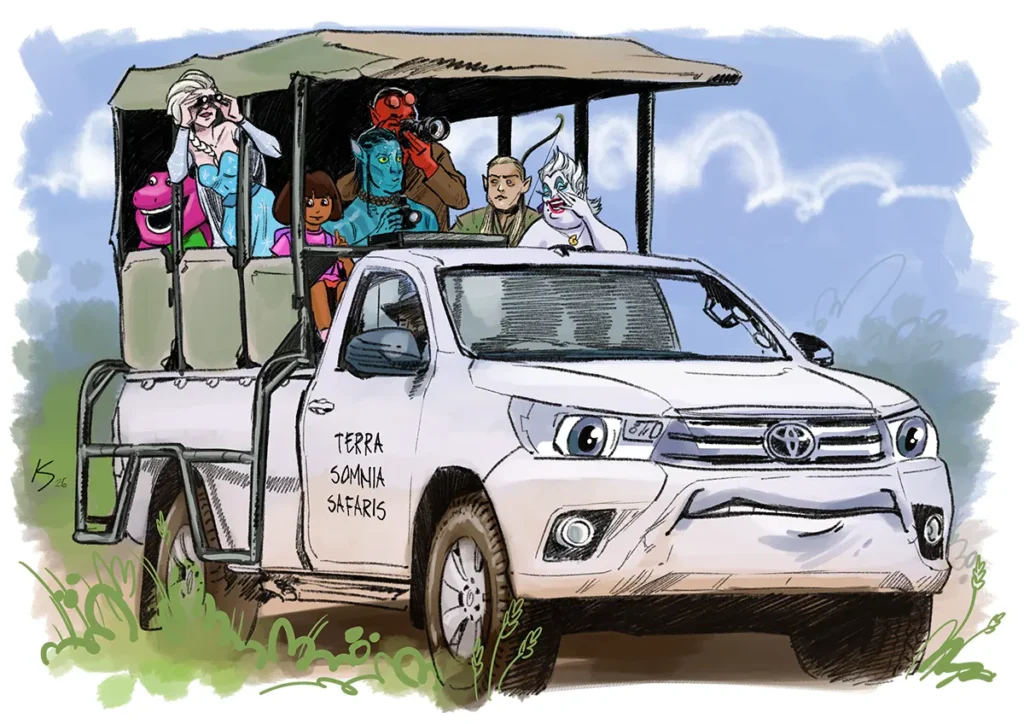
Atlantis, El Dorado, Lemuria, Kumari Kandam, Shambhala, Shangri-La. Places known for their beauty, wonder and mystery. Places spoken of in learned conversations and ancient texts. Places no one knows where, or even how, to find.
Life on Earth is filled with dreamers. Science has shown that most sentient creatures experience some form of REM sleep. What an elephant shrew or wandering albatross dreams of, however, remains an absolute mystery. Human dreams, on the other hand, are very well documented. One recurring sapien dream is to visit places no other being could ever reach.
Some people possess an extraordinary ability to share glimpses of these imagined worlds, allowing us to explore their paracosms. Think of Pandora from the Avatar franchise, or perhaps Westeros, Narnia or Middle-earth. Dreamscapes born in the minds of remarkable individuals with the ability to conjure entire universes.
Were the legendary lands mentioned above not perhaps the creations of similarly imaginative storytellers?
Historians and scholars generally agree that Plato used Atlantis as a philosophical allegory warning against moral decay and political hubris rather than as a historical account. Perhaps Plato was merely the James Cameron or Steven Spielberg of his time.
Humans have always been fascinated by the past. We sift through fragments of antiquity, attempting to reconstruct grand narratives of ancient lives and forgotten events. We may never know whether Atlantis truly vanished into the cold dark of the ocean, whether Shangri-La remains hidden in some inaccessible Himalayan valley, or whether El Dorado was ever more than a gilded dream of unimaginable wealth.
What we do know is that almost every ancient culture left records of dreams, and that despite all our technological advances, the dream state remains as primitive, raw, and unexplored as it was when sentience first emerged on Earth.
My fascination with dreams and imagination has often led me down unexpected paths, not only while actively imagining and dreaming, but also in studying how humanity has historically perceived the unknown.
That path eventually led me to terra incognita.
The phrase, likely introduced by Ptolemy around 150 AD, means “unknown land.” It reappeared prominently on maps during the Age of Discovery, marking regions that explorers had not yet charted. As maps became more accurate and humanity’s ability to document geography improved, the phrase gradually disappeared. The unknown receded. Blank spaces were filled. The mysteries faded.
To me, however, terra incognita has always possessed a deeply romantic quality. Unknown land. What a marvellous mystery to dream about.
Some months ago, I found myself wondering how one might regale a complete stranger with tales of Namibia. Not merely where it is, but what it feels like. How does one describe it? After much wandering through language, history, and imagination, I arrived at Terra Somnia—Land of Dreams.
For a brief moment, I considered Terra Incognita. It certainly evokes the spirit of exploration and discovery. Yet Namibia is no longer unknown. Its mountains have been mapped, its rivers charted, and its roads traced by satellite. The geography may be known, but the feeling remains elusive. Vast rolled-out plateaus stretch toward distant horizons. Unquenchably thirsty arid zones shimmer beneath crisp cyan skies. Clawed, furred, feathered, and toothed denizens inhabit landscapes that often seem more imagined than real.
And so Terra Somnia seemed more fitting.
Visitors frequently describe Namibia as otherworldly. It is a place that feels both ancient and untouched, familiar yet profoundly alien. In a world where satellite imagery can reveal nearly every corner of the planet, Namibia still retains something increasingly rare: the ability to inspire wonder.
Perhaps that is why myths such as Atlantis and Shangri-La continue to captivate us. They speak to a longing that survives in every generation. Burning desire to discover places that exist somewhere between reality and imagination.
Namibia may no longer be terra incognita, but it remains Terra Somnia; a land where reality still feels just a little like a dream.
Perhaps the unknown lands traced on the maps of yestercentury never vanished at all. Perhaps they simply moved somewhere far more difficult to chart: into the imagination.